

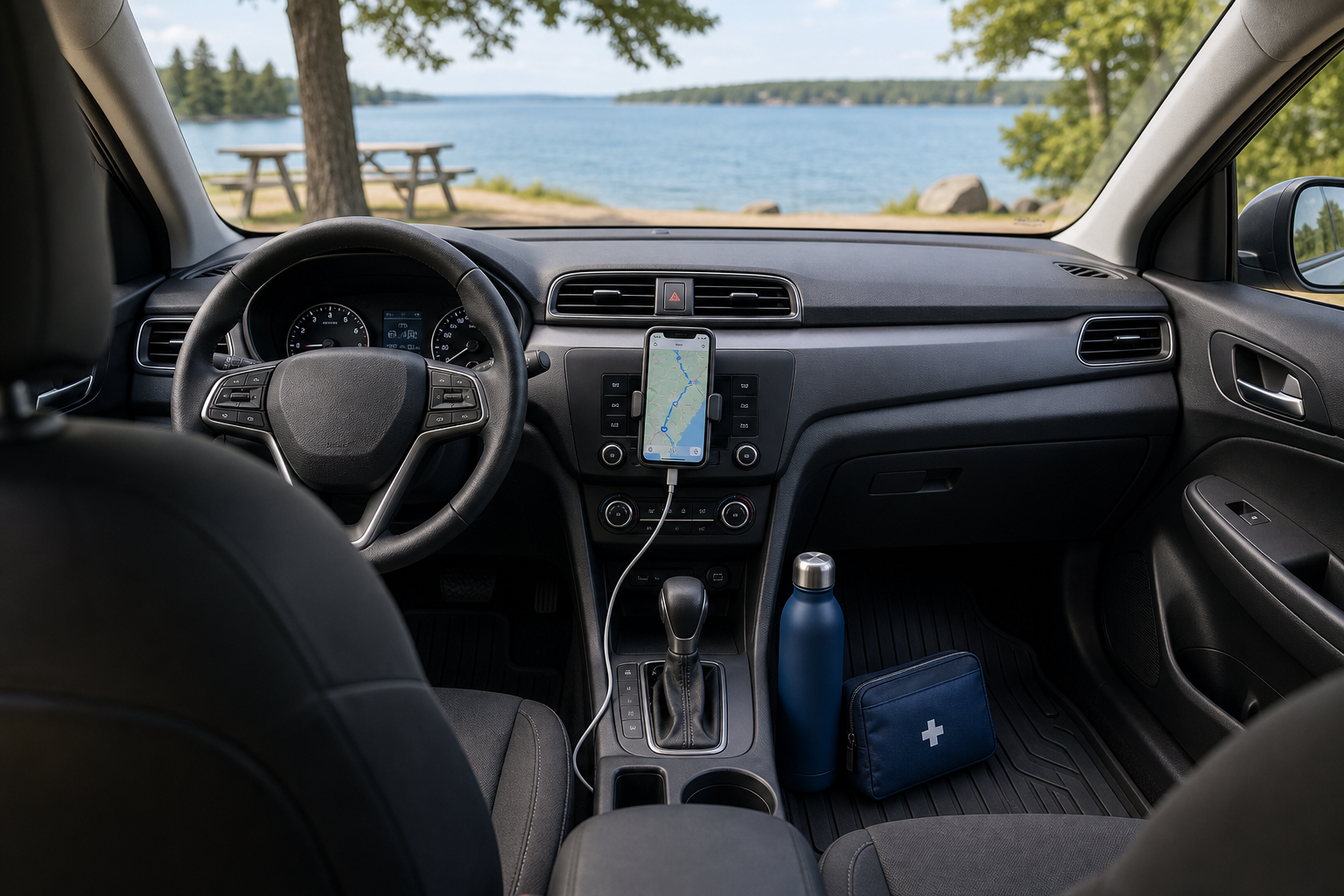
A good Canadian summer road trip starts before the first kilometre. Whether you are leaving Toronto for cottage country, following the Trans-Canada Highway, or planning a weekend around the Great Lakes, a few practical checks can make the cabin calmer and help prevent avoidable delays.
This Canadian summer road trip checklist combines official safety guidance with a realistic setup for navigation, charging, cleanup, and storage. Accessories can improve convenience, but they do not replace vehicle maintenance, attentive driving, or the instructions in your owner??Ts manual.
1. Check tire pressure before a long drive
Heat, highway speeds, passenger weight, and luggage all increase the demands on your tires. Transport Canada recommends measuring tire pressure when the tires are cold, checking the spare, and using the vehicle manufacturer??Ts recommended pressure rather than the maximum printed on the tire. Inspect the tread and sidewalls for uneven wear, cuts, cracks, bulges, or embedded objects as well.
Do this early enough that a technician can investigate anything unusual. A tire gauge belongs in the trip kit, but it is the pre-departure check??"not an accessory purchase??"that matters most.
2. Finish maintenance before packing the car
Review the owner??Ts manual and address warning lights before departure. Check fluid levels, exterior lights, wiper condition, and windshield washer fluid. If an oil change, brake inspection, battery test, or scheduled service is due, book it before the travel day. Drivers towing a trailer or carrying an unusually heavy load should confirm vehicle and tire limits with the manufacturer??Ts guidance.
3. Set navigation while the vehicle is parked
Enter the destination, review the route, and download any offline maps before moving. CAA advises drivers to stay focused on the road and handle distractions before leaving or after stopping. A magnetic rotation dashboard mobile holder may help keep a compatible phone in a consistent position, but mounting does not make interaction safe. Obey the distracted-driving laws where you travel and let a passenger handle changes whenever possible.
Place the screen where it does not block the windshield, controls, airbags, or the driver??Ts view. Confirm that the mount remains secure over bumps and that the phone can be removed without forcing the driver to reach across the cabin.
4. Plan charging without loose cables
Navigation, photos, and roadside communication can drain a phone quickly. Test every cable and adapter before the trip, and keep a charged power bank as a backup. Transport Canada??Ts trip-planning guidance recommends bringing a charging cable and considering a battery pack for longer journeys.
A retractable car phone charger can reduce cable clutter when its specifications match your device and vehicle outlet. Route it away from pedals, the steering column, the gear selector, and emergency controls. Do not leave batteries or electronics exposed to extreme heat inside a parked vehicle.
5. Pack an emergency kit you can reach
Build the kit for the route, weather, number of travellers, and distance between services. Useful basics can include drinking water, non-perishable snacks, a first-aid kit, flashlight, reflective warning devices, booster cables, basic tools, and required medication. Add sunscreen and insect protection for summer stops. Tell someone your route and expected arrival time when travelling through remote areas.
Keep heavy objects secured low in the cargo area. A well-stocked kit is less useful if it is buried under luggage, so place frequently needed items where they can be reached during a safe stop.
6. Clean the cabin before loading
Remove loose objects from the footwells, cup holders, and seat pockets. Debris near pedals is a safety concern, while crumbs and sand become harder to manage after several days on the road. A compact car vacuum cleaner can help with routine cabin cleanup when used only while parked and according to its electrical and filter instructions.
7. Protect high-wear areas from summer mess
Beach sand, campground mud, spilled drinks, and sudden rain can travel back into the car. Removable floor protection makes cleanup easier, but fit is critical. Mats must sit flat, remain secured, and never interfere with accelerator, brake, or clutch pedals. If considering UltraGuard Pro all-weather custom-fit car mats, verify the exact vehicle model and current fit information on the product page before ordering.
8. Check forecasts, road conditions, and fuel stops
Review Environment and Climate Change Canada alerts and the provincial or territorial 511 service for each part of the route. Plan fuel or charging stops with a margin for detours, traffic, and closed services. Summer construction, wildfire conditions, storms, and ferry schedules can change a route quickly, especially outside major cities.
9. Do a final two-minute departure check
- All passengers are buckled and child restraints are correctly installed.
- Luggage, water bottles, and emergency supplies are secured.
- Mirrors, seat position, climate controls, and navigation are set.
- The phone is charged and will not require driver handling.
- Doors, cargo areas, roof carriers, and trailer connections are secure.
- Nothing can slide into a pedal area.
Frequently asked questions
What should every Canadian road-trip emergency kit include?
The right kit depends on season and route, but start with water, snacks, first-aid supplies, a flashlight, reflective warning devices, booster cables, basic tools, charging options, and personal medication. Add route-specific supplies and learn how to use them before leaving.
Is it safe to use a phone mount while driving?
A mount can position a device, but it does not remove distraction or override local law. Set the route while parked, avoid handling the phone while driving, and use a passenger or stop safely when changes are needed.
When should tire pressure be checked?
Transport Canada recommends checking at least monthly and before a long trip, with the tires cold. Use the pressure specified by the vehicle manufacturer and remember to inspect the spare.
Make preparation part of the trip
The best road-trip setup is simple: maintain the vehicle, reduce distractions, secure the cabin, and pack for realistic delays. Choose accessories only when they fit the vehicle and solve a genuine problem. Before ordering, confirm the latest compatibility, specifications, availability, shipping, and return information on each product page.
Sources: Transport Canada tire safety guidance, Transport Canada trip-planning and emergency-kit guidance, and CAA distracted-driving guidance. Accessed July 19, 2026.